OPM RUGBY RFC
How it all began
For the first 20 years or so of existence Plymouth College was a school that played football and supplied the fledgling Plymouth Argyle with many of their players – 50 out of 500 for Argyle’s early years (1886-1903) before the club became a professional concern. A number of Argyle stars came from the neighbouring Mannamead School, founded slightly earlier than Plymouth College in 1854.
In that context it’s not surprising to learn that in Argyle’s first full season they played 20 games, some seven of which were either against Plymouth College or Mannamead School. Argyle reserves played less than half that, nine games, of which four were against Plymouth College 2nd XI.
In that first season, the captain of the College eleven was Ernest Babb and Ernest it was who came to captain Argyle in their second season. In those days the most keenly contested game locally for Plymouth College was their fixture against Mannamead School and when the latter was struggling courtesy of personnel issues in 1895 their merger with the College meant the loss of a major sporting encounter.
Football however had become a bit of a problem for the schoolboy game by this stage locally with many Services and other sides fielding non-commissioned officers and young men who were bigger, stronger and generally a little more physical in their approach to the game.
Given that most other schools that were playing winter sports in the area had opted for the oval shaped ball that only really left the Corporation Grammar School as ‘fair’ opposition and that fixture did “not have the aura of a great game.”
As it happened the school had earlier hesitated “between the Rugby and Association game” but “a serious accident which happened whilst we were playing the former, decided us in favour of the latter.”
There was a feeling that a change might be afoot:
“We must look further afield to those schools which, though it may not always be recognised, are now our real rivals: and I am sure, that in Kelly, Newton, or Exeter, we shall find something which will take the place of the Mannamead match, and will bear the good fruits that that has borne in the past. But these schools play Rugby, and sooner or later we shall have to change”
So wrote R Nettel in the Plymothian, the school magazine. Just three years earlier Nettel had become the first pupil to win a scholarship to Oxford. He continued:
“At the ‘Varsities a good Rugby player is thought more of than a correspondingly good ‘soccer’ man, and brings far more honour to his old school. With all due respect to the Old Boys’ Club, a few good Rugby players at either of the Universities would do much more for the School than the Xmas tour of the O.P.’s.”
He then added: “It is a common mistake to suppose that if Rugby were instituted nobody would be able to play at odd moments. I have questioned men from the great public schools, and everywhere I find that boys practice without changing, just as we do now. Of course no one can play either game properly without tumbling into ‘footer’ clothes.”
The reality was that the newly merged Plymouth and Mannamead College was now “the only first-class school in Devon that plays Association”, and with an eye on the future, they played their first game of rugby on 28 March 1896, against the Royal Naval Engineering Students:
“In consideration of our inferiority in weight, the Students generously allowed us the advantage of the wind for both parts of the game” .... “the game ended with the score:- 1 goal 2 tries (11 points) to 1 goal (5 points), in favour of the Students” ... “Altogether the school is to be congratulated on its first attempt at Rugby Football.”
Football continued to be the main game but “after the half-term, a few games of Rugby were played, which proved to be a very nice change from Association”.
This ambivalent situation continued for a few years until 9 October 1903 when 35-year-old George Gwyther, a full-blooded rugger man who had come to the school from Oxford University and who had a master’s degree from Cambridge, proposed to the School Debating Society that “Rugby Football should be introduced into the School”.
The motion was carried “with most unexpected unanimity, the minority consisting of one only”.
The decisive vote in favour of playing rugby at Plymouth College was doubtless helped by the fact that just a few months earlier one old boy, JR Walkey, had won a full blue at Cambridge, the first past pupil so to do. Walkey had played a prominent part in those oval ball games that had been organised after the Amalgamation with Mannamead and would have been something of a local hero back at Ford Park.
Whatever the reasons the change to the new discipline was swift.
On 5 March 1904 the School 1st XV played a practice game against Argaum Reserves.
Argaum fielded several of their first team players though and not only outmanoeuvred their younger opposition they also substantially outweighed them and scored an easy seven tries, two of which they converted, while the School failed to score. There was an even greater tale of woe against “our future rivals,” Kelly, on 16 March. Seen as being the footballing fixture that would replace the old bi-annual contest with Mannamead School, the first blood went convincingly to Kelly by “6 goals 8 tries to nil”.
Small wonder therefore to read that punch-drunk members of the 1st XV wrote, in an unprecedented three page post-match appraisal “we have gratefully accepted the kind offer of the Argaum team to send up players regularly every Wednesday next Christmas term to play, not against us but among us and so raise the level of play generally”.
Nor was it just the 1st XV that had been introduced to the game by this stage. Throughout February and March almost fifty boys ‒ a third of the school ‒ had been involved in a 12-a-side, inter-house, senior competition which was won, quite convincingly, by North Town House who together with Palmer’s House had most of the 1st XV players.
In October “the opening match of the season set at rest any doubts we may have had before as to the great improvement of our team since last spring” and although the Arguam side that played that day was markedly weaker than the one faced that spring the fact “we only had one try scored against us, was very encouraging”. Particularly, it must be said because Mr Pocock (who had himself originally joined the school in amalgamation year ‒ 1896 and had completed his schooling the previous year), had scored for the School and that try had been converted giving the side their first rugby victory.
Later in the month a Wednesday game against the Border Regiment was a slightly different story “their arrival at our ground somewhat appalled us, as they averaged some two stone per man more than our team”. Inevitably it was another heavy defeat for the inexperienced boys (46-0) but there were encouraging signs and there was an interesting footnote from the match reporters;
“Our heartiest thanks are due to the Officers of the Border Regiment for the interest they afterwards showed in our team.”
The true test of the new sport however came on Saturday 22 October 1904 - “The first real match in football against a rival school that we have enjoyed since the last College v Mannamead match in November 1895, and was looked forward to with great anticipation. Our determination was to wipe off as many points as possible from the score which Kelly had run up against us in the friendly game they had given us last spring.”
In the event a 51-0 deficit was reduced to a margin of 20-3. FG Cooper it was who became the first boy at the school to score for the 1st XV.
It was enough to inspire the editors of the first Plymothian of 1905 to wax thus;
“Whatever difficulty Editors of this Magazine may sometimes find in distinguishing any event of the year which they are reviewing as of unusual importance, there can be no doubt that on this occasion at least we do not err in so distinguishing the appearance of our first Rugby XV. It was during the year 1904 that we won our first Rugby victory, that we scored our first try against Kelly College, that we first afforded more than one Devonshire school a hard-fought game of football; and these facts will assuredly be remembered by the future historian of the school.”
They then speculated about the prospect of beating a fellow Devonshire school in the coming season and followed it with a eulogy to the man most responsible for the change ‒ George Gwyther;
“The really great advance made by the school in the knowledge of the Rugby game, is due, to an even larger extent than most of us realise, to the great interest shown by Mr Gwyther in our progress. His self-sacrifice in giving up his spare time, both to coaching the XV. And refereeing in the games, and to attending all our matches at home and away, must raise a feeling of gratitude, especially of course in the XV, but also in the whole school.”
Again there was a note of optimism for the coming season and after years of sporting fixtures against Service sides it was a healthy move to see Kelly, Newton College, Allhallows’ School and Exeter School among the forthcoming encounters, including a 2nd XV game against Kelly.
Argaum were still on the list though and again they trounced the lighter boys (63-5), but come November 1905 Newton College became the first school scalp claimed by Plymouth College. They also beat the Three Towns Law Students, in very poor weather, “by 4 tries to 1 ... Owing to the heavy ball no tries were converted”. Meanwhile the seconds beat Kelly 11-9.
Kelly were undoubtedly the principal “enemy” ‒ for the Cadet Corps in their regular moorland battles, for the fives teams (such as could be raised by the School), by the cricket XI and now, at last, by a rugby XV. In 1906 we find two pages given over to this fixture and clearly it had been well promoted around throughout the School;
“This is the first time since the old College-Mannamead days that the school has turned up in such numbers to watch a football match, and we won; the moral is obvious”. The scoreline was less so; 8-3, in favour of the School, but it was a notable victory and one that meant the encounter was destined to be a major fixture for many years to come.
Inevitably, but by no means instantly, the old boys, now Old Plymothians and Mannameadians, decided to follow suit.
There had been no ‘Past v Present’ football encounter in the 1903/4 season and with another date being scratched there were only three round ball OPM matches played ‒Christmas Eve against the Border Regiment at Crownhill (lost 5-4), Boxing Day against St Austell (lost 2-1) and finally at Launceston (lost 3-1). One contemporary noted that there was “one redeeming feature in the above rather poor record, namely, we always turned out with a full team! That in itself almost constitutes a record.”
He added: “Sooner or later Old Boys will have to consider the question of following the School’s example and changing to Rugby, and the Secretary who undertakes to place 15 OPMs on the field will have my heartiest sympathies. Although the changes will be regrettable, it will be unavoidable. Even playing members of the Club are not endowed with perpetual youth, and one of our most regular players was referred to at the Club Dinner as an “hoary headed old man”! Unless new blood is infused into the team it cannot exist many years more.”
It was no surprise therefore when at the Annual Meeting of the OPM Club, on 21 December 1906, it was decided to adopt “the Rugby instead of the Association game in consonance with the same change at the school.”
The meeting was held at the Plymouth Law Chambers and the Headmaster, Francis Colson, presided. Mr EE Rogers was elected the first OPM Rugby captain, with ES Griggs, vice-captain and JA Brown, secretary. Officials of the OPM Cricket, Hockey, Tennis and Chess Clubs were also elected and it was reported that overall club membership had risen from 183 in 1905 to 203.
Financially the club was reasonably healthy with £29.6s.2d and a further £9.9s.0d in pre-paid subscriptions to be added, although it was also noted that there were ‘many subscriptions in arrears.’
By the 1907-08 season the place of the new game was well and truly consolidated at Ford Park. The 1st XV won 11 of their 14 encounters, including a game against the newly-formed OPM XV.
Fixtures for the OPM XV however were still on an ad-hoc basis and by the time war broke out in 1914 there had been little progress towards forming a regular side with a full set of fixtures.
During the war there was no question of building up either a team or a fixture list and in the immediate aftermath of the war, with so many young lives lost, there appears to have been little appetite for any of the Old Boys activities, however as the twenties dawned so did fresh hope for all the sections of the OPM Club.
In the 1921-22 Season an OPM XV were held to a 3-3 draw by the School Team, but appeared to have had little in the way of other fixtures. The next season there was a similar fixture played, but games against 2nd Battalion and Kingsbridge were cancelled owing to the condition of the pitches. For the
1923-24 season three matches were played and yet more were pencilled in for the 1924-25 season, including fixtures against Plympton, Argaum, Newton Blues, Kingsbridge and the School.
At the Main Clubs’ Annual Dinner in January 1925, P A Harris, the main club secretary said he would like to see an OPM Rugger Team running in Plymouth. The main difficulty appeared to be a ground.
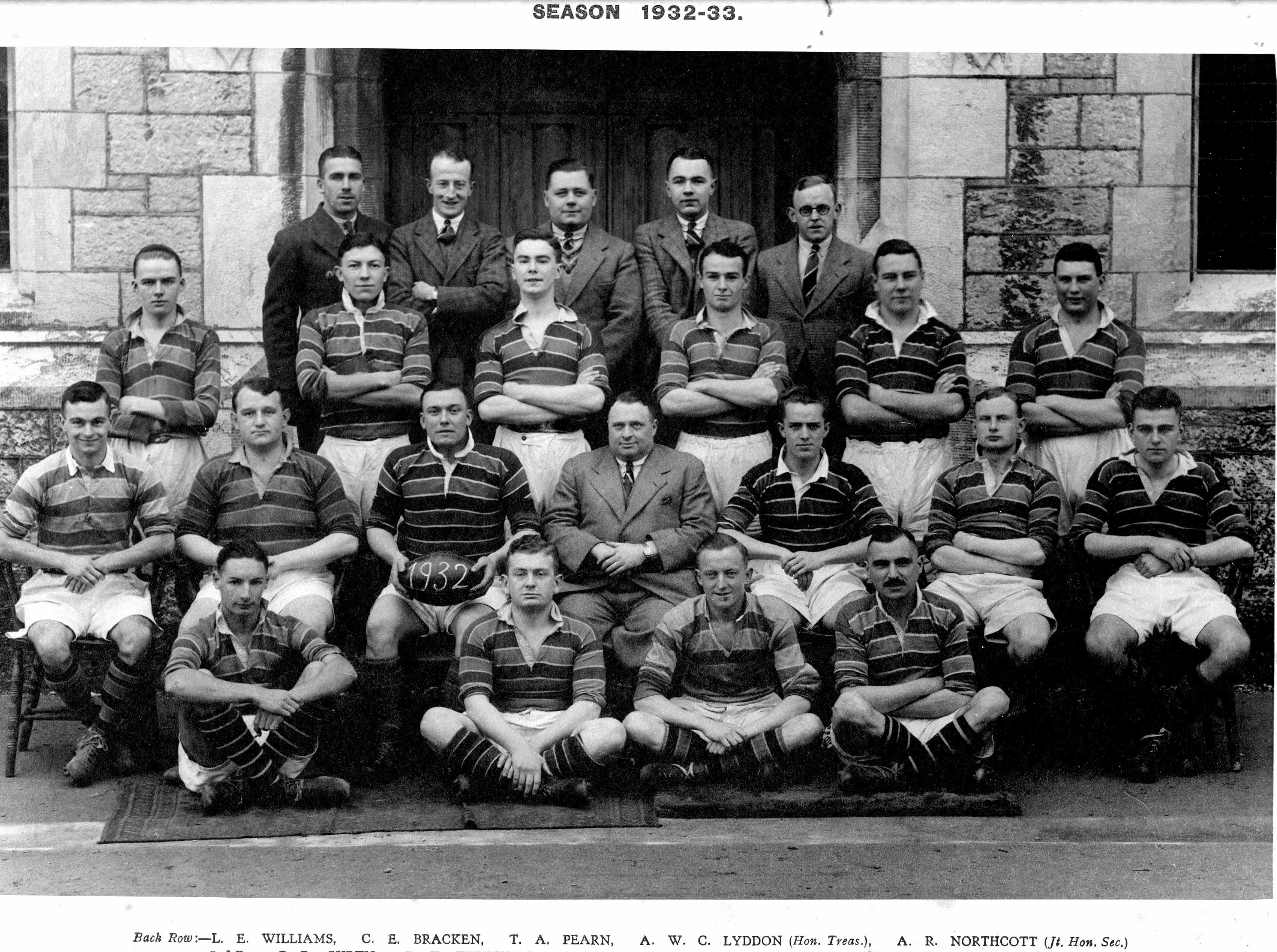
In February 1926 26 members attended the inaugural General Meeting of the OPM Rugby Club and P A Harris was elected as Captain for the coming season. A ground near Crownhill was acquired for use on Saturdays and the club registered 30 playing members and several active non-playing members. The 1926-27 season was the first full season that an OPM Rugby Club played.
Some 36 fixtures took place and although the OPMs only won 13 of them, the overall points deficit was only eight points (for 346 points, against 354), a number of the defeats had been by one or two points only. The 2nd XV played seven games and 68 players, ‘all of whom were Old Boys’ partook in the season’s fixtures. On an individual level, founder member GL Wakeham was selected for the Plymouth and District XV to play against Albion Reserves and was heartily congratulated.
Clearly the Club was back on its feet and the Head (Francis Dale) acknowledged the fact; “The OPM Club, broken through the war, was in great difficulties when I first came [in 1920]; but now, through the work of a devoted few – I must mention JC Bowering, PA Harris, DF Gibbs, NF Crawshaw – the Club has recovered a very effective vigour; the Cricket, the strong new Rugby Football Club, the Dinner, the Dance, all flourish now: and one may feel as one sees the OPM tie about the street that College in Plymouth is in the midst of friends.”